
Understanding Chinese Medicine Organ Patterns: A Practical Introduction
Sep 15, 2026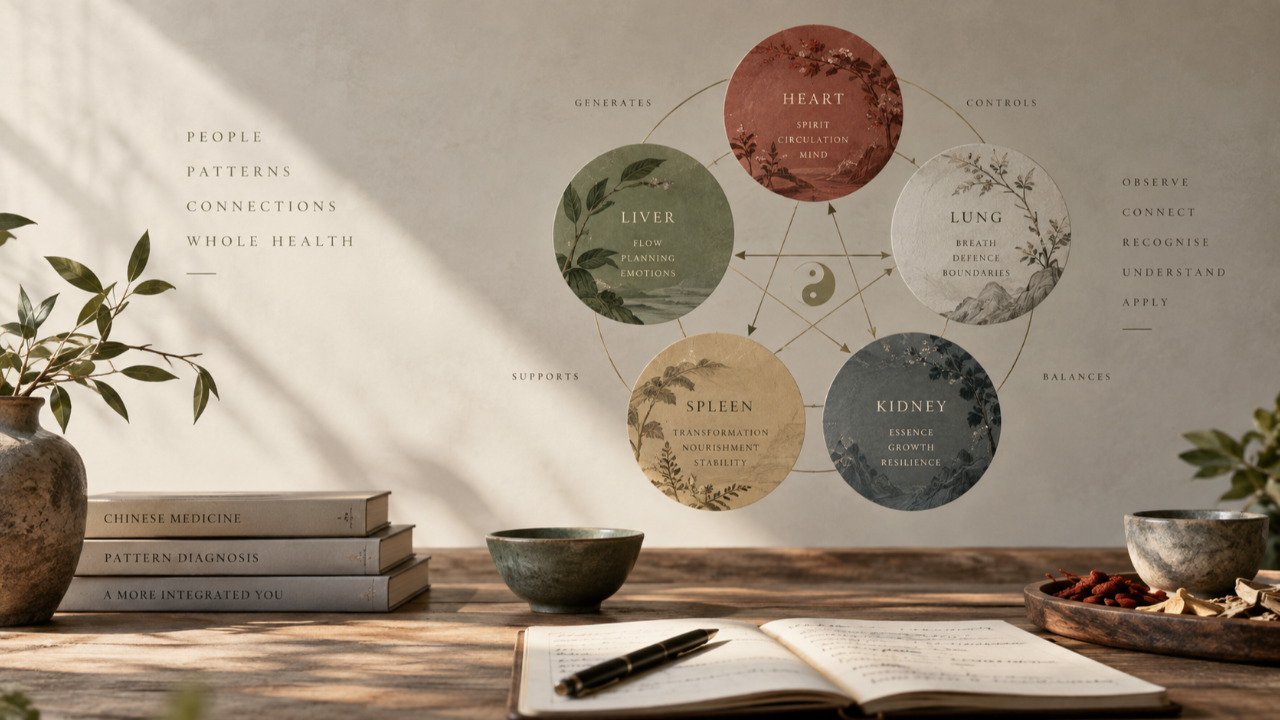
If you've spent any time with Chinese medicine, you've encountered the terminology. Liver Qi stagnation. Kidney Yang deficiency. Spleen Qi deficiency. Liver Yang rising.
You may have heard these terms dozens of times in training and still find yourself unsure what they're actually describing — or why they matter clinically.
This article is about that gap. Not about memorising more patterns, but about understanding what an organ pattern is in Chinese medicine and why learning to work with them changes the way you see patients.
What Does "Pattern" Mean in Chinese Medicine?
A pattern in Chinese medicine is a coherent picture of dysfunction — a cluster of signs and symptoms that, taken together, point toward a particular kind of imbalance in the body's functional systems.
A pattern is not a diagnosis in the Western sense. It doesn't name a disease. It describes what is happening in terms of how the body's functional systems are behaving — what's deficient, what's in excess, where things are moving when they shouldn't be, or failing to move when they should.
The same person might present with a Western diagnosis and a Chinese medicine pattern simultaneously. The Western diagnosis names the condition; the Chinese medicine pattern describes the functional picture that is generating the symptoms.
Why "Liver", "Kidney", and "Spleen" Don't Mean What You Might Expect
This is the point that trips up most practitioners approaching Chinese medicine from a Western clinical background.
When Chinese medicine talks about the Liver, it is not talking about the hepatic organ of Western physiology in any simple, direct way. It's describing a functional system — a set of physiological and psychological functions that ancient clinicians grouped together because they observed them behaving together, influencing each other, and breaking down together.
The Liver, in Chinese medicine terms, governs the smooth flow of Qi and Blood throughout the body. It has a particular relationship with emotional regulation — especially frustration, irritability, and the capacity to move forward with plans. It influences the tendons, the eyes, and menstrual function. Its corresponding meridian runs from the foot up the medial leg, through the pelvis and abdomen, into the chest and throat.
The Kidney governs constitutional strength, the deepest reserves of vitality, reproductive and developmental function, and the bones. It has a traditional relationship with fear and the capacity to remain grounded under pressure.
The Spleen governs the transformation and transportation of nutrition from food — the extraction of what Chinese medicine calls Post-Heaven Qi — and is involved in the management of fluids, muscular tone, and the capacity to concentrate and think clearly.
None of these correspond exactly to their Western anatomical namesakes. This isn't a limitation of Chinese medicine — it's a different system of organisation. One that, once understood on its own terms, has considerable clinical precision.
The key shift is this: when you hear "Liver" in a Chinese medicine context, think functional system with defined characteristics, not anatomical organ with Western pathophysiology.
A Pattern Is a Cluster, Not a Single Symptom
The practical implication of this is important: you can't diagnose a Chinese medicine pattern from a single symptom.
Fatigue might be Spleen Qi deficiency. Or Kidney Yang deficiency. Or Blood deficiency. Or Liver Qi stagnation affecting the Stomach's ability to digest and produce Qi. Each of these patterns has fatigue as a possible component — and each calls for a different clinical response.
What distinguishes one from another is the full picture. The quality of the fatigue. What makes it better or worse. What accompanies it. The tongue. The pulse. The way the person holds themselves and speaks about what's happening.
Pattern diagnosis is essentially reading a constellation and asking: what single underlying functional picture best explains all of this together?
The pattern is a description of that underlying picture. Not a label to attach to a symptom.
Deficiency, Excess, and Movement
Patterns can be organised around a few recurring themes that structure most of what you'll encounter clinically.
Deficiency describes insufficient resources — not enough Qi, Blood, Yin, or Yang to meet the body's functional demands. Deficiency patterns tend to present with exhaustion, weakness, pallor, sensitivity to cold or heat depending on what's deficient, and a general lack of resilience.
Excess describes something that is present in too great a quantity, or blocked and backing up — heat, cold, dampness, phlegm, or stagnation. Excess patterns tend to present with more intensity: pain that is fixed or distending, heaviness, heat sensations, agitation.
Movement is a theme that cuts across both. Chinese medicine is deeply concerned with the directional quality of function. Qi should descend in the Stomach and ascend in the Spleen. The Liver should move Qi smoothly outward and upward. When these movements are disrupted — when things rise when they should descend, or stagnate when they should flow — specific patterns emerge.
Understanding these themes lets you read a clinical picture faster. You're not trying to remember which symptom belongs to which syndrome. You're asking: what is too much, too little, or moving in the wrong direction?
Examples of Common Organ-Pattern Logic
Liver Qi Stagnation
The Liver's primary function in Chinese medicine is the smooth, free flow of Qi. When this function is disrupted — through chronic stress, emotional frustration, sedentary lifestyle, or constitutional tendency — Qi backs up.
The result is a pattern characterised by: a feeling of tension or constraint (often across the chest and flanks), irritability or frustration that is worse under stress, digestive discomfort with a tendency toward bloating, and menstrual irregularity or premenstrual tension in women. The pulse tends to be wiry; the tongue may be slightly purple at the edges.
Notice that this constellation makes sense in terms of the Liver's described functions. The Liver governs smooth flow and emotional regulation. When it fails, both of those domains are affected simultaneously.
Liver Yang Rising
This often develops from a pattern of Liver or Kidney Yin deficiency — insufficient substance to anchor the Yang, which then rises upward.
The presentation typically includes headaches that are worse with stress (often temporal or vertex), dizziness, irritability, and sometimes tinnitus. The relationship to Kidney is important here: the Kidney and Liver are closely linked in Chinese medicine (they share a Yin-level pairing in the channel system), and Kidney Yin supports Liver Yin. When the root is insufficient, the branch — Liver Yang — rises upward.
Kidney Deficiency
Kidney patterns divide primarily into Kidney Yin deficiency and Kidney Yang deficiency, with Kidney Essence (Jing) deficiency as a deeper layer.
Kidney Yang deficiency presents with cold, especially in the lower back and extremities, fatigue that is worse in the morning, urinary frequency, and low libido. There is insufficient warmth and motivating force.
Kidney Yin deficiency presents with heat — a sensation of heat in the palms, soles, and sternum in the afternoon or evening; night sweats; disturbed sleep; a dry quality. There is insufficient cool, nourishing substance.
Both involve the Kidney — but they are functionally opposite and require opposite treatment.
Spleen Qi Deficiency
The Spleen transforms food into usable Qi and Blood and transports nutrients to the rest of the body. When Spleen Qi is insufficient, this process fails.
The result is fatigue (particularly after eating), poor appetite, loose stools, a tendency toward bloating, and difficulty concentrating. The muscles lose tone. The face may become puffy. The tongue is usually pale and swollen; the pulse is soft or deficient.
This pattern is extremely common in clinical practice — and easily missed by practitioners who are treating fatigue as a simple energy problem rather than a digestive-functional one.
Why One Western Condition May Contain Several Chinese Medicine Patterns
This is one of the most clinically useful ideas in Chinese medicine, and one that becomes clearer the longer you practise.
Two people with the same Western diagnosis can present with completely different Chinese medicine patterns — because Chinese medicine is describing the functional picture beneath the named condition, and that functional picture varies from person to person.
Consider tremor as a symptom. In Chinese medicine terms, tremor can arise from internal wind — but internal wind has several sources. It can be generated by Liver Yang rising (excess) or by Blood and Yin deficiency failing to nourish the sinews (deficiency). The clinical presentation, the constitutional picture, the accompanying signs — all of these will be different. The treatment rationale will be different too.
This is why Chinese medicine can legitimately offer something distinct even where the Western diagnosis is already established. It's not making a competing claim about disease mechanism. It's providing a different level of description — the individual functional picture — that the named diagnosis doesn't capture.
It also means that pattern assessment has to be individual. You're not asking "what's the Chinese medicine pattern for this condition?" You're asking "what's the functional picture in this particular person?"
Why Learning Patterns Visually Helps
Pattern recognition is a visual and spatial skill as much as an intellectual one. The relationships between signs, symptoms, substances, organs, and meridians become easier to hold in mind when you can see them laid out clearly — when you can look at a pattern and trace the logic that connects its components.
This is why visual reference tools tend to accelerate this kind of learning. You're not just reading descriptions; you're building a mental map of how the system's parts relate.
Next Step: TCM Study Cards
The free TCM Study Cards were designed to support exactly this stage of learning — building visual familiarity with common organ patterns and their characteristic signs, so that recognition becomes easier and faster over time.
They're a practical reference you can use while studying and while preparing for clinical sessions.
Get the free TCM Study Cards here:
https://www.bhaktiatsu.com/TCM-Study-Cards
If you found this useful, you might also want to read: How Chinese Medicine Pattern Diagnosis Works
Stay connected with news and updates!
Join our mailing list to receive the latest news and updates from our team.
Don't worry, your information will not be shared.
We hate SPAM. We will never sell your information, for any reason.
